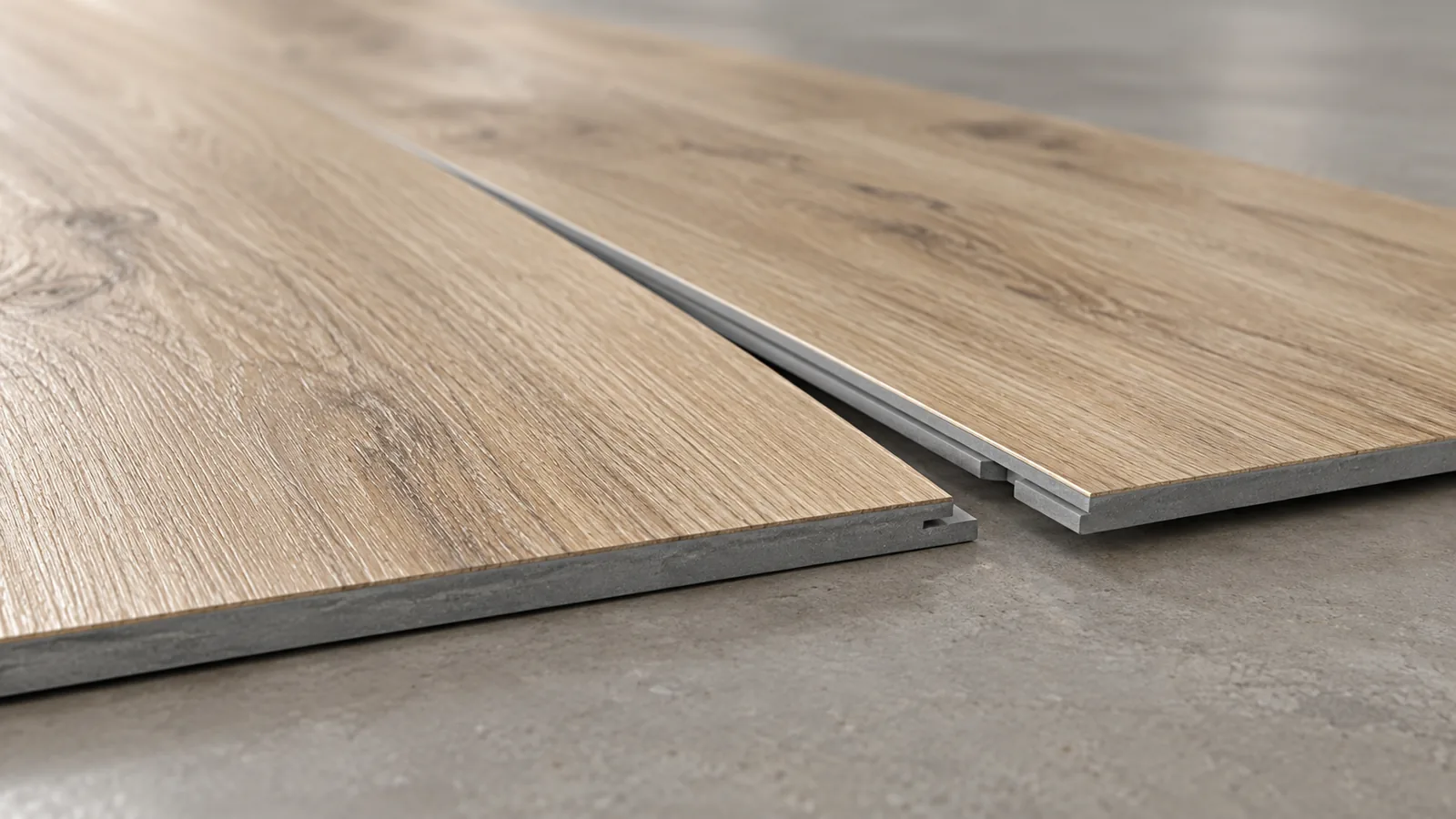
Two SPC planks click together neatly. The joint looks tight, the surface feels level, and the sample makes a good first impression. But that demonstration leaves an important question unanswered: how much force can the profiled edge withstand before it fractures?
When you develop your flooring collection, you can compare colours, dimensions and wear-layer specifications relatively easily. SPC flooring edge strength deserves the same attention—and evidence that goes beyond clicking two samples together.
Why the edge of your SPC plank matters
The profiled edges connect individual planks into a floating floor. Their ability to stay intact matters to the performance of those connections.
ASTM explains that brittle or excessively flexed profiles can fracture, potentially allowing gaps or differences in height between adjoining planks. Profiles that are too soft or flexible may disengage. Its F3781 test method addresses the behaviour of these edges under vertical loading. Source: ASTM F3781-25
For your collection, this creates a useful distinction. A sample demonstration lets you assess how a product assembles. A controlled test provides a measured result for a defined aspect of its performance.
Both belong in your evaluation.
What ASTM F3781 actually measures
ASTM F3781 measures the fracture resistance of a modular flooring product’s profiled edge under a vertical force applied at a specified rate, until initial fracture occurs.
The focus is the profiled edge. The result should not be presented as a universal measure of every aspect of “click strength” or converted into a maximum furniture weight for an installed floor. Those are different questions from the one this test addresses. Source: ASTM F3781-25
When a supplier gives you a strength figure, ask which method produced it. A number becomes useful when you know what was tested and how.
What the 17 lbf requirement means
The final SCS-111 Version 2.1 certification update, announced on 12 August 2026, incorporates ASTM F3781 and specifies a minimum vertical edge-strength result of 17 pounds-force, or lbf, within the ASSURE Certified programme.
The distinction matters: ASTM F3781 is the test method; SCS-111 establishes this certification threshold.
SCS also provides a transition period. Existing certificate holders move to Version 2.1 at their next annual audit, with all holders required to be audited against that version by 31 May 2027. During this transition, check the applicable version and supporting evidence rather than assuming every existing certificate already demonstrates the updated requirement. Source: SCS Standards, August 2026
ASSURE was developed for rigid core flooring sold in North America, regardless of manufacturing location. Its requirements also cover other performance and material attributes. For your European collection, an edge-strength result can inform product evaluation, while your destination-market requirements still need their own review. Source: RFCI
What to request before approving your collection
A practical approach is to connect each performance claim to the product you intend to order.
| Ask for | What you want to establish |
|---|---|
| The test method and edition | Exactly which property was measured |
| The tested product identification | Whether the report corresponds to your proposed construction |
| The profile and edge details | Which parts of the product the results cover |
| The measured results and assessment criteria | How the reported performance was evaluated |
| The report date and laboratory | Who performed the testing and when |
| The certificate scope and version, where applicable | Whether the certification claim covers your product and the relevant requirements |
If your proposed specification differs from the tested product, ask the supplier to explain the report’s applicability. Avoid filling that gap with assumptions.
For your private-label programme, keep the agreed specification, approved sample and supporting reports together. This makes later discussions about substitutions or changes much more precise.
Connect laboratory evidence with production checks
Laboratory testing and shipment inspection answer different questions. Your test evidence addresses defined performance characteristics. Your inspection plan should check the agreed characteristics of the goods being shipped.
When setting up your product-specific pre-shipment inspection, identify which checks belong in the inspection and which require separate laboratory evidence. Do not let a simple assembly check stand in for a documented strength result.
That gives your collection a clearer approval basis: an agreed product, relevant evidence and checks tied to the order.
Develop your SPC collection with clearer specifications
Bring edge performance into the discussion alongside your decor, dimensions and wear layer. Asking for the right evidence before you approve a product gives you a stronger basis for comparing your options.
Planning an SPC flooring collection? Send Euro Vietnam your specification, target market and testing requirements so we can discuss suitable sourcing options for your programme.