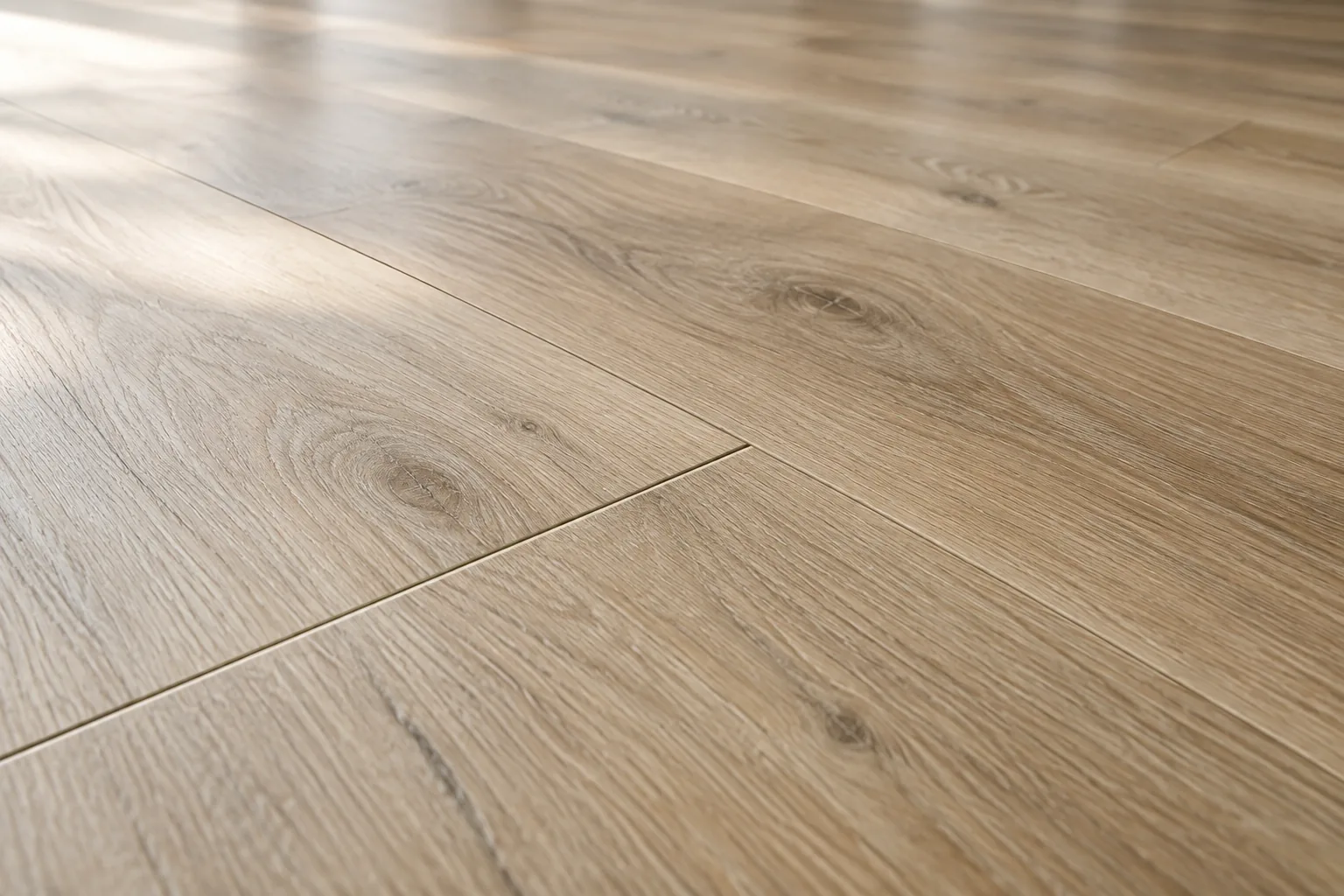
A wood-look SPC floor can have a convincing decor and still disappoint when several planks are clicked together. The problem may be at the edges: a shiny outline around a matte surface, an abrupt change in colour, or a bevel that draws more attention than the wood design. For a flooring buyer, that small detail deserves a place in the sample review.
What is a bevel in SPC flooring?
A bevel is the shaped edge that makes the boundary between adjacent planks visible. Its appearance repeats across the installed floor, so a detail that seems minor on a single sample can become a strong pattern across a room.
That pattern can be desirable. A clearly defined edge can emphasise individual boards, while a restrained bevel can help create a quieter, more continuous appearance. The useful question is whether the edge suits the collection you are building.
Look beyond the decor name. Two samples described as “natural oak” can create very different floors once their edge colour, gloss and profile come into view. The bevel deserves the same deliberate choice as the surface finish.
Why Optibevel is part of this conversation
On 10 September 2026, i4F announced that Vietnam-based AMY GRUPO had signed an Optibevel licence agreement for new flooring collections. According to i4F, the technology uses a high-precision laser to create decorative bevels directly in the profiling line. The company describes closer matching between the bevel and surface in gloss, design and texture, alongside flexibility across different formats. Read the announcement from i4F.
Those are the technology provider’s claims. For a buyer, they create useful questions to ask of a finished sample. A licence announcement alone does not establish the appearance, performance or availability of a particular product.
The practical interest is straightforward: can the edge look like a considered part of the flooring design, and can that result be reproduced consistently in the collection being ordered?
What to check on assembled samples
Start with several full-size planks assembled according to the product’s installation instructions. Include both long-edge and end joints. A small cut sample is useful for handling and colour discussions, but it cannot show how the joint pattern develops across a larger area.
Review the assembly in ordinary room lighting, then with light falling across the surface from the side. Step back as well as looking closely.
Pay attention to four details:
- Gloss: Does the edge catch the light more strongly than the face? Decide whether that contrast supports the intended finish.
- Colour and texture: Does the transition into the bevel feel deliberate? A contrasting edge may suit one design and interrupt another.
- Profile consistency: Compare the apparent width and depth along several joints, including where short and long edges meet.
- Overall rhythm: From a normal viewing distance, do you notice the wood design first, or a grid of prominent outlines?
These observations help define a visual preference. They should not be used to infer wear resistance, locking strength or other technical properties that require their own evidence.
Separate a bevel from a joint problem
A designed recess at the edge is different from an unintended opening between planks. A change in surface reflection is also different from a height difference between neighbouring boards.
If a joint looks wrong, establish what you are seeing before accepting or rejecting the sample. Review the installation, the profile and the product specification with the supplier. Agree on how relevant dimensions and joint conditions will be checked, using the requirements and tolerances for that particular product.
The visual depth of a bevel should not be confused with the overall thickness of the plank. Review construction and thickness separately from the decorative effect.
Turn the approved look into a purchasing requirement
“Good bevel quality” leaves too much room for interpretation. Keep an identified, approved reference assembly and record the finish you accepted. Photos under agreed lighting can support that reference, although they should not replace the physical samples.
Before placing an order, clarify the intended edge treatment, the relevant specification, the reference samples and the acceptance criteria. Where different plank formats are involved, review samples of the formats you plan to buy.
Carry those agreed requirements into the product-specific pre-shipment inspection. The inspection scope should reflect the ordered product and its approved reference, including the appearance and assembly checks agreed for that order.
A well-chosen bevel gives the decor a convincing finish at every joint. Evaluating it on assembled planks helps buyers make a clearer decision before a sample becomes a collection.
Cover image: AI-generated editorial illustration of flooring joints; not a photograph of an Optibevel product.