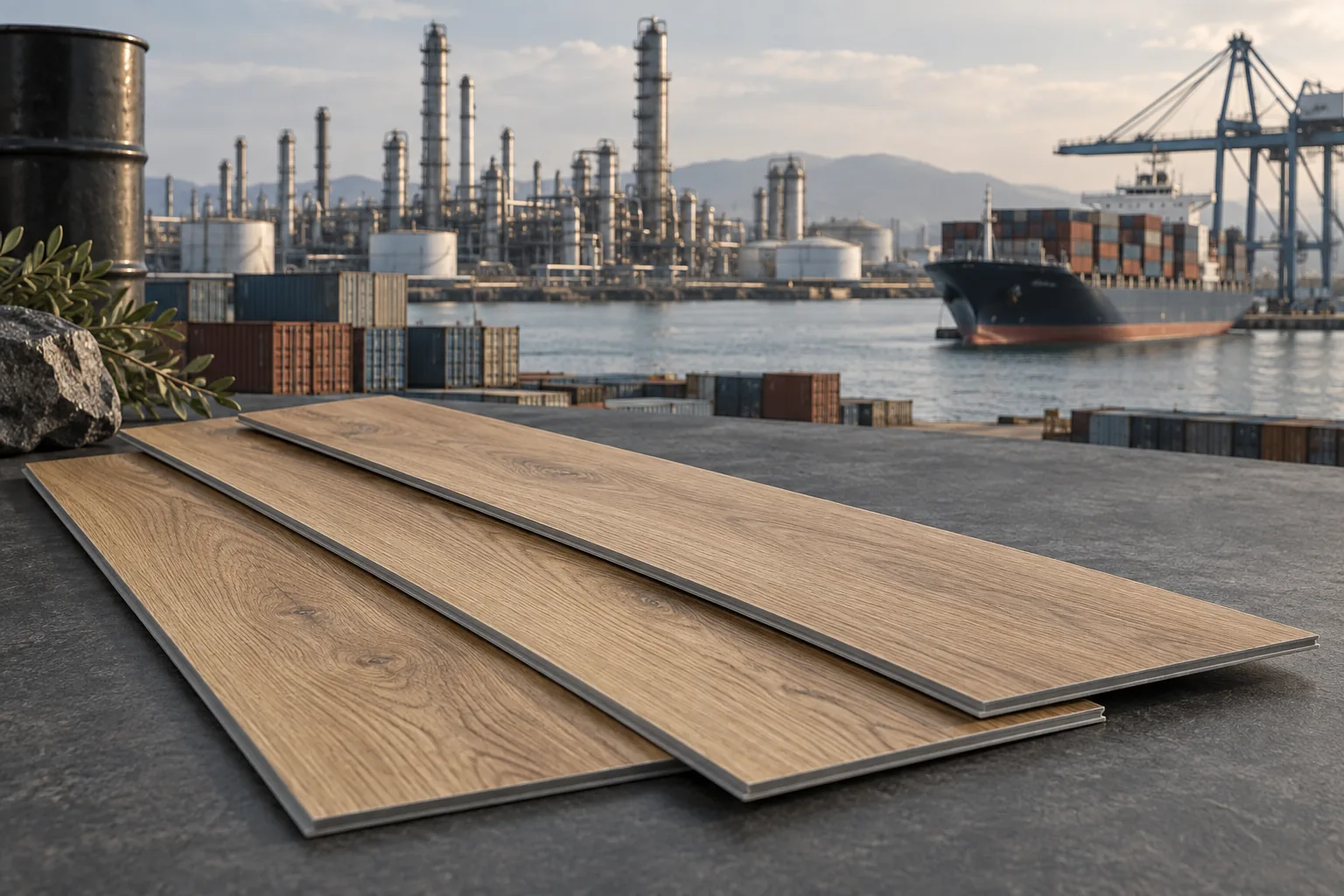
Your flooring specification has not changed. The dimensions, decor, wear layer and packaging are exactly the same. Yet the quotation for your next order is different. Oil prices can be part of the explanation: they influence some of the raw materials used in PVC products and the fuel needed to move them. But the connection between a barrel of oil and your price per square metre involves several separate costs.
Understanding those costs helps you assess a revised quotation, plan your next order and distinguish a genuine increase from a vague explanation that “raw materials have gone up.”
How oil connects to PVC
PVC is the polymer used in conventional SPC flooring, many LVT products and a wide range of vinyl wall coverings, films and profiles.
In a common production route, manufacturers combine chlorine derived from salt with ethylene, which can come from oil or natural gas. Further processing produces PVC resin—the material later blended into a formulation suitable for the finished product. This means PVC has a connection to fossil feedstocks, but describing it as simply “made from oil” leaves out an important part of the process. ECVM: How PVC is produced
Oil-derived naphtha is one feedstock used to produce basic petrochemicals. Gas-derived feedstocks provide another route. Consequently, different producers can face different raw-material costs even when they supply the same broad category of plastic. U.S. Energy Information Administration
There are also acetylene-based routes to the intermediate used to make PVC. The production route matters, so a crude-oil chart alone cannot explain every movement in PVC resin prices. Johnson Matthey: Vinyl chloride monomer production
Why your SPC floor does not follow oil prices one for one
An SPC plank contains more than PVC resin. Its rigid core combines polymer with mineral material, typically calcium carbonate, and additives. The finished product also includes its specified decorative surface, protective layers and, where applicable, an attached backing. Tarkett’s description of its SPC construction, for example, identifies calcium carbonate in the core. Tarkett: Elegance Rigid 55
Your quotation must also cover processing, machining, packaging and other manufacturing costs.
If oil rises by 10%, you therefore cannot apply that same 10% to the price of a finished floor. First, the relevant feedstock and resin prices would need to change. Then the effect would depend on how much those inputs contribute to the product’s cost.
Consider a simplified illustration. If PVC resin represented 25% of a product’s manufacturing cost and the resin price increased by 10%, the direct increase in total manufacturing cost would be 2.5%, assuming everything else stayed unchanged.
Those figures are illustrative, not a Euro Vietnam cost breakdown. They show why an input-price increase and a finished-product price increase are different calculations.
The same principle applies across PVC-containing products. SPC flooring, flexible vinyl and wall panels have different formulations and constructions, so their exposure will differ.
Energy adds another layer
Raw materials are only part of the connection.
Producing chlorine requires electricity: the chlor-alkali process uses electrolysis to separate products from salt water. Manufacturing the finished flooring also requires energy for processing and operating equipment. Euro Chlor: How chlorine is made
However, electricity, natural gas and crude oil are separate markets. A factory’s energy costs depend on its location, energy mix and purchasing arrangements. Higher oil prices do not automatically mean its electricity bill rises by the same percentage.
For your quotation, the useful distinction is between resin costs, factory energy costs and transport costs. Combining all three under “oil prices” makes a price change harder to understand.
Freight can change even when the factory price stays stable
Your flooring may leave the factory at the same price while costing more to reach its destination.
Shipping lines use fuel-related adjustments to account for changes in marine fuel costs. For example, Maersk’s published Bunker Adjustment Factor methodology uses a fuel-price reference and a trade-specific factor, with scheduled reviews. That mechanism illustrates how fuel movements can reach a freight quotation after a delay. The applicable terms must be checked for your shipment. Maersk: BAF methodology
A practical calculation is:
Additional freight per m² = additional shipment cost ÷ loaded square metres
If freight increases by $600 on a shipment containing 3,000 m², the additional freight cost is $0.20/m². This is a calculation example, not a current freight rate or a standard loading quantity.
The actual quantity depends on the product, packing arrangement and shipment limits. That is why comparing only the price of a container can obscure what transport costs your collection per square metre.
Why a price change may arrive later
Today’s oil price is not necessarily the price behind today’s flooring production.
A manufacturer may still be using previously purchased resin. Another may be buying replacement stock at a different price. Supply agreements and freight adjustments can also operate on different schedules.
PVC has its own supply-and-demand cycle. Producer capacity, customer demand and raw-material availability influence what the market will accept. Westlake’s reporting describes both this commodity cycle and the possibility that selling-price changes lag behind changes in raw-material costs. Westlake: Annual report
The same reasoning applies when oil falls. Lower oil prices may ease part of the cost pressure, but they do not establish an immediate discount on every finished PVC product.
What to check in your next quotation
When a revised price arrives, compare it against the same product and commercial basis:
- Product specification: Confirm the construction, dimensions, wear layer, surface finish, backing and packaging.
- Cost explanation: Ask whether the movement comes from resin, other materials, energy or transport.
- Price validity: Check how long the quotation remains valid and what conditions secure it.
- Freight assumptions: Confirm the destination, shipping period, loaded quantity and included charges.
- Delivery terms: Establish which transport costs are included and which you arrange separately.
A lower quotation is useful only when you understand what it includes. Our article on what a factory quotation does not tell you explores that comparison in more detail.
For your next SPC or PVC-containing product order, oil is a useful market signal. The decision should rest on the actual product specification, current quotation and delivery assumptions.