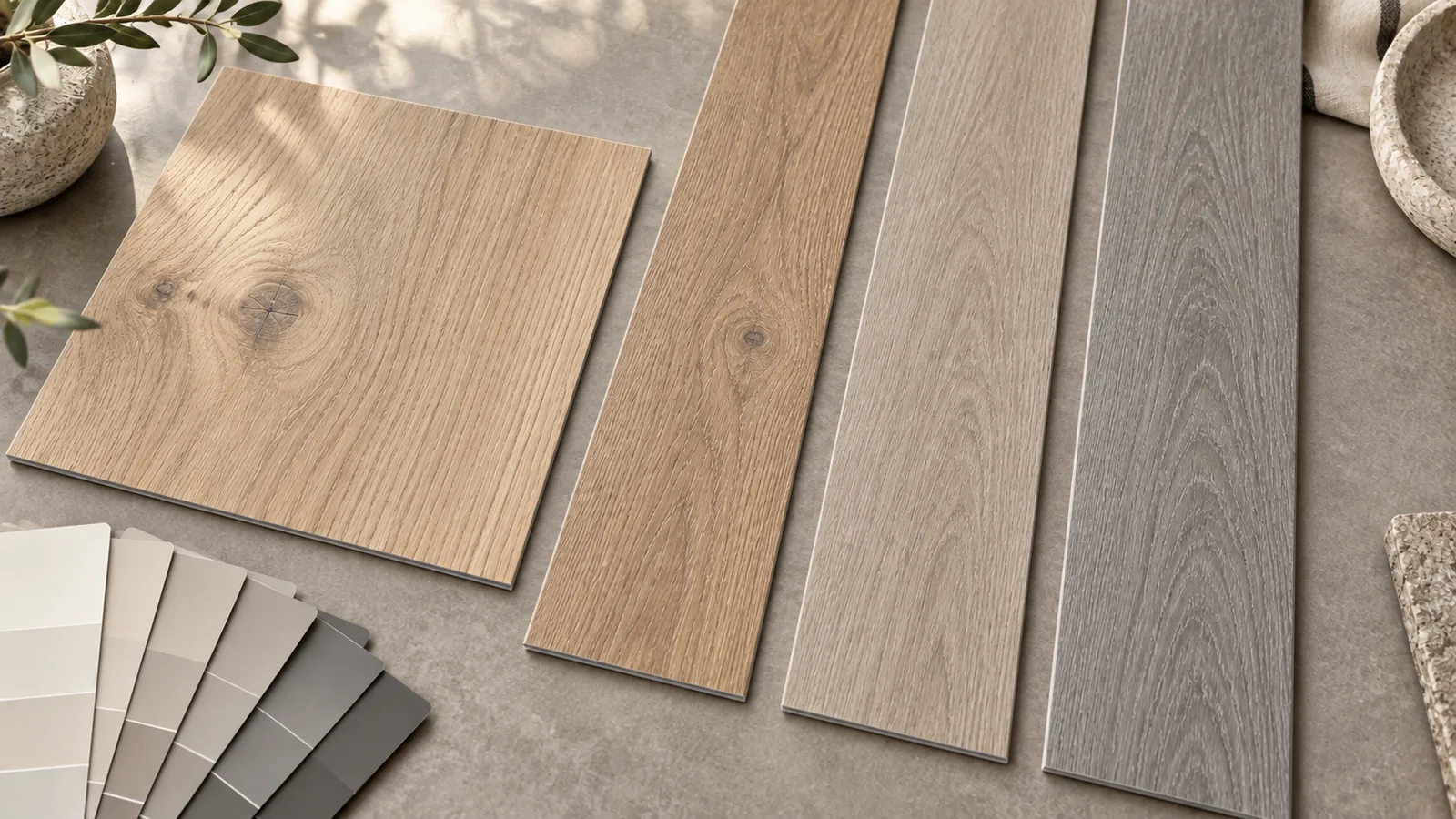
A flooring decor does not have to begin with the nearest film in a factory library. It can begin with a timber board, an existing floor, a material from another interior category or properly prepared digital artwork.
The work is not simply to copy a colour. It is to interpret the reference, choose a viable decor route and then judge the colour, gloss and surface together on a finished flooring sample.
Euro Vietnam works directly with decorative-film producers in Vietnam as well as flooring manufacturers. That allows the development process to start with the visual target rather than the catalogue of one flooring factory.
First decide what the reference is asking for
A physical board contains more information than one average colour. It may have a warm or cool base tone, variation between earlywood and latewood, mineral streaks, knots, contrast, grain direction and a particular scale.
An existing floor adds another layer: its coating, gloss, embossing and bevel affect how the decor is perceived. A digital file may show the intended pattern clearly but provide no reliable physical colour reference unless it has been prepared and approved for that purpose.
The first discussion therefore needs to identify what must be preserved.
Is the customer trying to match the overall tone of an established collection? Is one distinctive grain feature essential? Should the new floor reproduce the reference closely, or use it as a direction while reducing contrast or repetition? Is the target a natural timber appearance, a cleaner commercial interpretation or a match to another product in the room?
Without that decision, two technically competent suppliers can create two different “matches” and both believe they followed the brief.
Three starting points require three different checks
A physical board
The board is assessed for tone, grain, contrast, scale and the effect of its existing finish. It should be clean, representative and large enough to show the character that matters. A small cut piece may contain a feature that is not representative of the full surface.
An existing flooring sample
This is useful because it shows the decor as a finished floor. It can also hide the source image beneath embossing, coating and wear layers. The development team has to separate the printed information from the surface effect that may need to be recreated by a different process.
Digital artwork
Artwork can provide greater control over scale, repeat and individual visual elements. It still needs a reliable colour target. A screen image is useful for discussion; it is not a stable production approval standard because displays, exports and viewing conditions differ.
In each case, the reference should be identified and retained. “Match the sample we sent” becomes difficult to manage if several similar boards are circulating and nobody knows which one controls the next revision.
The route is chosen before the flooring sample is made
Once the visual target is understood, the next decision is how to reproduce it.
The simplest route may be an existing decorative film that is genuinely close enough. If it meets the product and commercial brief, there is no value in creating a custom route merely to call it bespoke.
Where the available films miss the target, a decorative-film producer can develop or adjust the decor directly. Depending on the source and product, that may involve colour separation, tonal correction, scale and repeat work, or the development of a new printed reference.
Direct digital print is another option where the product, factory equipment and required production volume support it. It can be useful for designs that benefit from greater variation or do not fit conventional film economics. It is not automatically the better route; output, cost, repeatability and the intended surface still have to be considered.
At this stage, the flooring factory and film producer have different responsibilities. The film producer develops the printed visual. The flooring factory has to turn that visual into the actual construction, surface and format the customer will buy.
Film approval is not flooring approval
A matched film can look convincing on its own and different once it becomes a floor.
The transparent wear layer, UV coating, gloss level, embossing, pressing and bevel all change the way light moves across the decor. Ultra-matt can make a colour feel quieter and deeper. A stronger texture can create contrast that is not visible on the flat film. EIR only works when the texture and printed features align convincingly.
For that reason, the useful first milestone is not a loose film swatch. It is a finished flooring sample using the intended or representative surface route.
The sequence is:
reference → colour and decor interpretation → film or digital route → finished flooring sample → review and refinement
Keeping that sequence visible prevents a common misunderstanding: a successful print trial does not mean the finished product has already been matched.
What can normally happen in 7–14 days
A first colour-matched finished flooring sample can typically be produced in approximately 7–14 days, depending on the reference and manufacturing route.
That timing is realistic when the starting reference is clear, the relevant film and flooring teams can schedule the work, and the first route does not require extensive artwork reconstruction or new tooling. It is a first finished sample, not a promise of final approval or production readiness.
More time may be needed when:
- the physical reference contains wide natural variation;
- the digital source is incomplete or has no reliable colour standard;
- several gloss or surface directions need to be compared;
- the selected decor has to align with a new EIR texture;
- the product uses a specialist format or construction;
- or the first sample shows that the printed colour and finished surface need separate corrections.
The fastest route is the one that creates a useful decision, not merely the first object that can be sent by courier.
Colour, gloss and surface are reviewed together
Sample review should separate three questions.
Is the printed colour correct?
Look at the base tone, undertone, contrast and important grain features against the controlling reference.
Is the gloss correct?
The same print can look lighter, colder or more artificial under a reflective coating. A low-gloss target should be judged at the intended finish, not inferred from an uncoated film.
Does the surface support the decor?
Embossing should reinforce the intended material character. With EIR, registration matters. With stone and tile directions, the surface scale and edge treatment can change whether the product feels continuous or visibly modular.
Samples should be compared side by side under consistent light, then viewed from the distances and angles at which the floor will actually be seen. Photographs are valuable for recording comments and sharing progress, but they should not become the sole colour approval reference.
Refinement needs a precise instruction
“Make it more natural” is not a production instruction.
A useful review identifies whether the change sits in the print, finish or texture. The base may need to be less red. Dark grain may need lower contrast. The overall gloss may be too high. A texture may be visually fighting the grain. The plank may need more variation across the set.
That distinction allows the right supplier to make the right correction. It also prevents a film producer from changing colour to compensate for a flooring finish that should have been adjusted elsewhere.
Each revision should remain connected to the reference and the previous sample. Otherwise, development can become a series of isolated preferences rather than controlled movement toward the agreed target.
Source visibility creates options, not identical output
Knowing the decorative-film source makes future matching and alternative manufacturing options more practical. It reduces dependence on one flooring factory's internal film library and gives the buyer a clearer route back to the visual basis of the product.
It does not mean the same film will look identical on every factory line. Coating, lamination, embossing, pressing and process control can still change the finished result. A move to another manufacturer therefore requires a new finished-flooring approval, even where the decor film remains the same.
The useful control is not ownership language for its own sake. It is a visible chain from the original reference to the decor source, approved film or print, finished master sample and later production standard.
That chain gives the buyer more freedom to develop the product and more clarity if the manufacturing route ever needs to change.
Cover image: AI-generated editorial illustration.